

The two trees who saved us 25 years ago
and why I'm thinking about them today

August 31, 2025 - first quarter moon in Sagittarius
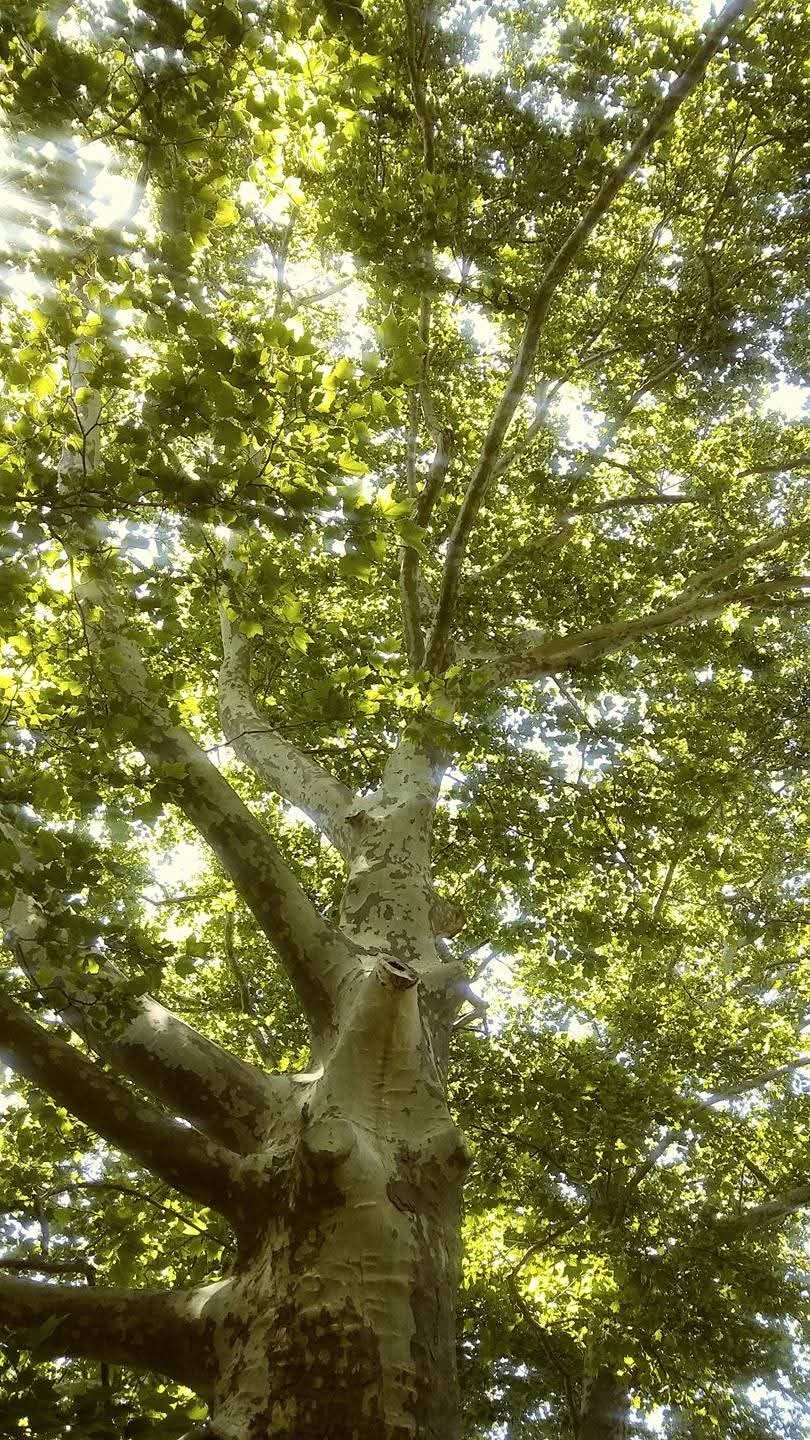
In late August, the two 150-year-old sycamore trees on the side of our house make their presence very known, shedding and sharing their elephant skin bark with the ground leaving behind soft yellow-green patches of tender new tree skin. (Why do they do this? An afternoon of research reveals no one really knows. Some think that sycamore bark is thin, but tough, and cannot expand with the tree’s growth. Others suggest that it’s in anticipation of an increased need through winter for bark photosynthesis.1)
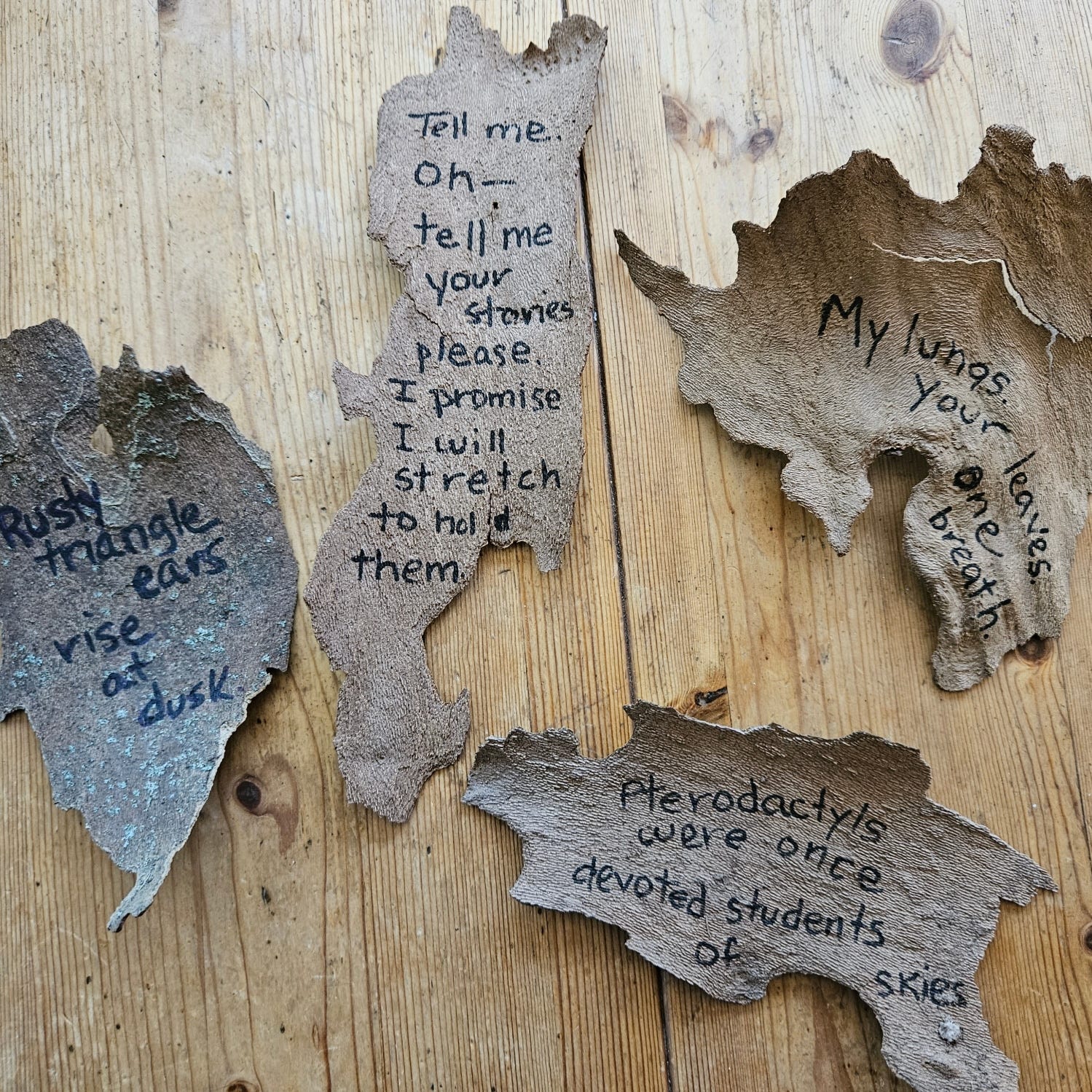
In the nearly 30 years I have lived in this house, these trees have woven themselves into our lives and into many of the poems and articles I’ve written. They even show up in my writer’s bio. A few years ago I used their bark as the “paper” on which I wrote some tiny poems. (Pics below.)
The sycamores are embedded so deeply in our daily lives that they became family, as important and present as my human family members. In my heart (and, yes, aloud too) call them grandmother and grandfather. And one long ago August day, I’m pretty sure they saved our lives.
On that steamy summer afternoon, the weather service warned of imminent severe storms. Back then, severe storms in this region usually meant thunderstorms with heavy rains and frequent lightning. Sometimes it meant the edge of a hurricane passing through. Very, very infrequently it could mean a tornado. But I’d never seen what this storm brought.
I was looking out my kitchen window to where the two sycamores stand to the west south-west of our house. That put them directly in the path of the approaching weather. I could feel the trees unease so I gathered my then toddlers into the only windowless space in the house, a tiny powder room. Moments later straight line winds slammed into the neighborhood. My children and I huddled and waited for the keening roar to stop.
Two or three minutes later things got quiet and we crept out. I looked out the kitchen window and saw a line of trees with their tops snapped off, the roof peeled off our barn, and debris everywhere except in the immediate area of our home. The house was untouched and the sycamores stood tall and serene despite a line of topped trees leading up to them and continuing on the other side of the house for another hundred feet. I know, in my bones, those trees kept our house, and us, safe that day. I’ve never stopped being grateful.
What Surprises Me the Most


is how you endure, even
as carpenter ants tunnel deeper and more
of you is broken and falling over the wild
violets in a cascade of heartwood dust.

I remember you stood serene, breaking
the axe of those winds on that steaming
day straight-line storms peeled
the barn roof and uprooted

that young white pine on the hill.
Yet this age-tempered house and its
soft-bodied cargo stood.
Do you remember?

Who else? What else remains because
you steadily raise crooked gray-green
branches over red clay soil? If I could
learn to speak sycamore, would you

tell me? If we could entangle your finest
roots with my fragile neurons what
would we know about each other?
In my imagination you compose the most gracious of poems.
I’ve been thinking about this story both because of the time of year, but also because I keep reading/seeing stories about people putting themselves between danger and endangered people. People demonstrating how they value the safety of neighbors and community members both human and other-than-human.
There’s a quote from biologist, author, and founder of biomimicry2, Janine Benyus, that lives in my head (and on sticky notes in random places in my house). “Life creates conditions conducive to life.”
It feels like that’s what I’ve been seeing in action. Despite many, too many, decidedly life-threatening actions and events, pockets (oases perhaps?) of Life are appearing in the form of people creating the conditions for other beings to continue to live even in the face of what looks, on the surface, like overwhelming odds.
Observing these oases in action lifts my state of mind. Because if there wasn’t a strong root system—a sturdy metaphoric and/or literal tap and rugged interconnected roots and hyphae—stabilizing and nourishing these pocket oases, then no one would have the footing they needed to rise. And people are definitely finding their footing and rising.
The sycamores remind me daily that there is solid ground for us when we interconnect our roots, stand together, and create conditions conducive to life. Who in your ecosystem offers that reminder?
With love from the sycamores and I,
Tracie
If you’re looking for a word-loving, creative, kind community experience, why not join me Oct 3-5, 2025 in Unity Village, MO (Kansas City metro area) at the Power of Words conference? I’m offering an experiential workshop encouraging you to think in the cadence of birdsong and creek murmur: Touching Wild: An embodied, ecosentient collaboration with poetry. It’s an invitation to use the power of words to explore the space, the ecotone, between we humans conditioned to think of ourselves as separate from nature and the ecosystems our bodies remember as home.
“Why the Sycamore Sheds Its Bark.” by Douglas Steele and Fiona Watt.
A field of study where solutions are inspired by nature. It’s fascinating and applies to fields as diverse as engineering, architecture, medicine and even social innovation. Lots more info to be found at the Biomimicry Institute.
Beautiful! I love the phrase "I could feel the trees unease."
These are beautiful words and a wonderful reminder for our times. Standing tall together on solid grounds with intertwining roots - just like the trees.